2026 Business Generosity Report
The Human Edge:
How Generosity Offsets AI Risk and Supercharges Company Culture
In June 2026, goBeyondProfit and Georgia CEO surveyed 232 business executives running companies and 1,000 employed adults across Georgia to understand the perceptions and impacts of business generosity.
Summary of Findings:
New data confirms: Employees are willing to devote their careers to companies that operate generously.
A striking number say they’ve stayed in a lower-paying job or turned down a higher-paying offer just to stay somewhere they consider generous. And when they experience tangible business generosity, they report more energy to collaborate, higher productivity, and stronger engagement.
This report is the benchmark for what effective business generosity looks like in practice.
Positioned correctly, generosity is a direct answer to the shared fear this survey uncovered: that AI will cost the workplace its human connection. Trust and connection matter anytime, but when a business must cut costs, rapidly adopt new ways of operating, eliminate positions, or ask employees to do more with less, trust drops, anxiety rises, and the case for generosity gets stronger.
Generosity becomes tactical: the clearest way to deliver what people need most while a business works through hard decisions.
Companies building a track record of generosity now — not as a charitable line item, but as a working guide for how people are treated at every point of contact — are the ones positioned to convert this year’s shared anxiety into ongoing trust.
An Essential Element: Generosity’s Measurable Effect on Employee Behavior
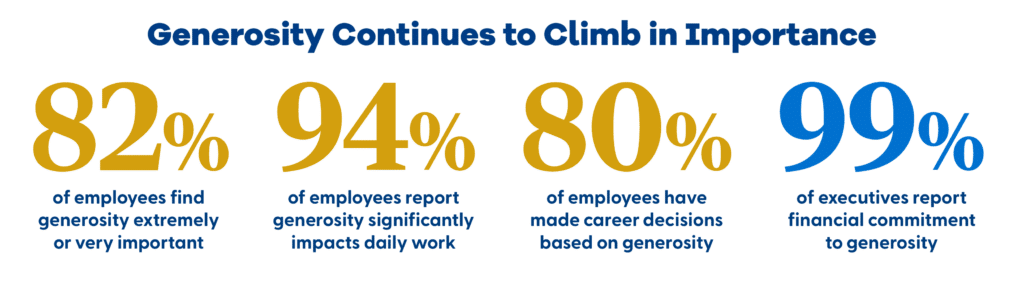
82% of employees say it’s very or extremely important to work for a generous company. This is an all-time high, up from 75% in 2022 and 49% in 2019.
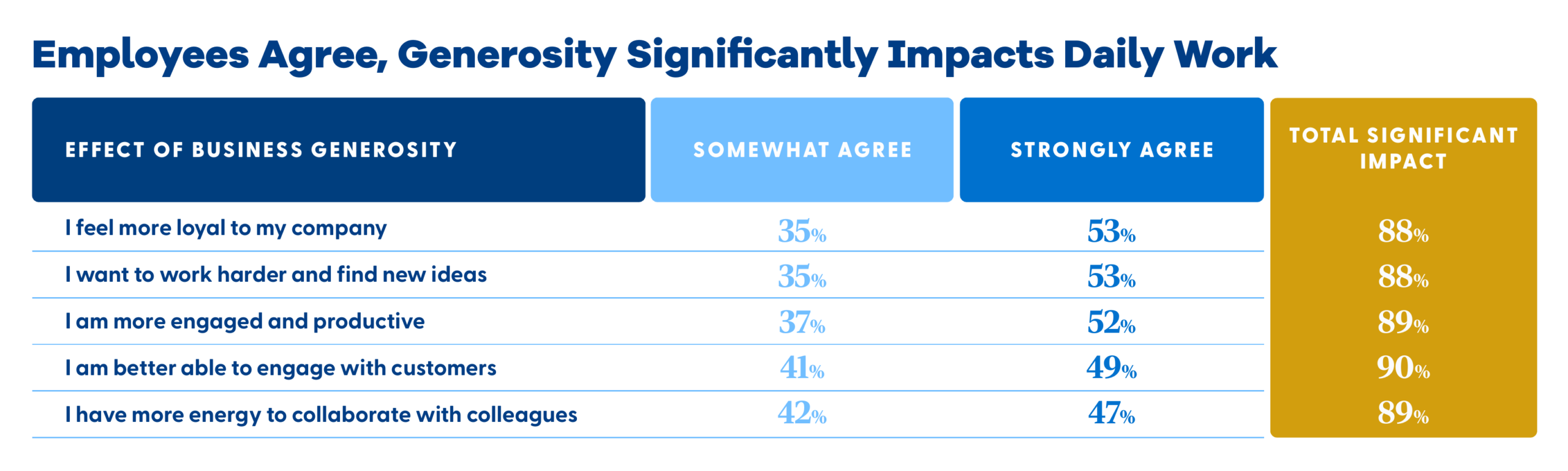
94% say generosity has a significant impact on their day-to-day work, and 55% strongly agree. Specifically, generosity makes employees more loyal, more engaged and productive, more willing to find new ideas, better able to serve customers, and more energized to collaborate with colleagues.
Employees are reinforcing these findings with their career and financial decisions: 46% have stayed at a generous company longer despite believing they could earn more elsewhere, and 18% have taken an actual pay cut to work somewhere generous. Altogether, 80% have made at least one career decision — leaving, rejecting an offer, pursuing a job, staying, or taking a pay cut — based on a company’s generosity.
Executives are responding: 64% report increasing their investment in generosity, and 35% more say they’re holding steady, nearly all in. Ask an executive what it means to be a generous company, and you’ll get a confident answer. But ask an employee the same question, and you’ll get a significantly different one. That disconnect is costing companies. All generosity counts, but some investments have a higher return. Learn More →
From Expected to Exceptional: The Generosity Benchmark
When survey respondents were asked to name what generosity means to them, employees elevate humanity inside the business: first and foremost, employee care that goes above and beyond (38%), then company culture (27%), then how the business treats customers and its supply chain (20%), and only then charitable giving (15%). Executives rank it in reverse.
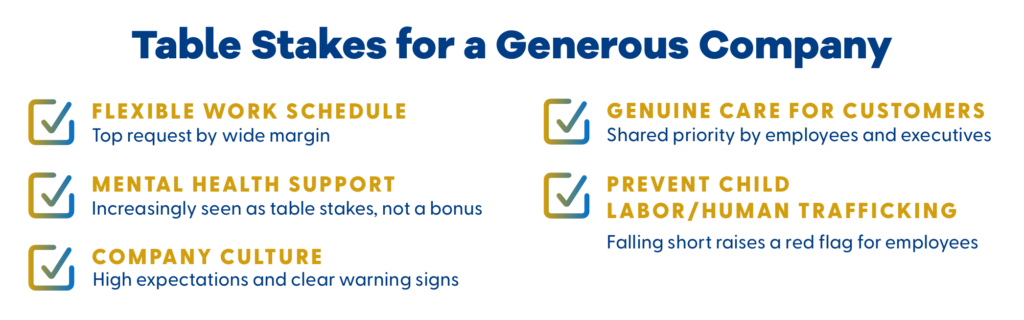
When asked to weigh in on specific tactical generosity efforts in each category, most of what employees now expect as a baseline don’t require new budget, but underdelivering costs more than it used to in disengagement, eroding trust, and loss of goodwill that compounds.
The real opportunities are the generosity investments that received outsized credit and still impress employees precisely because fewer companies offer them. Learn More →
The AI Accelerant: Generosity’s Role in Protecting Company Culture
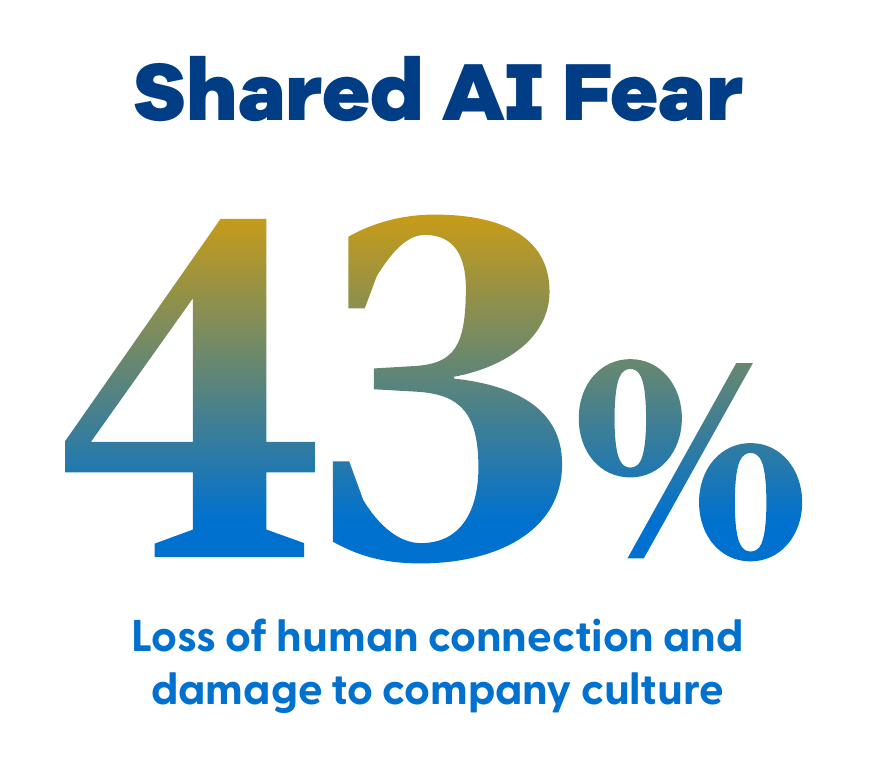
AI’s impact on the workplace isn’t landing well: 67% of employees and 54% of executives report mixed or negative feelings about it. 43% of both employees and executives name the same top risk — loss of human connection and damage to company culture — signaling that AI represents a major threat to the company culture leaders have spent years building.
72% of employees do not believe that company values are actively driving AI integration. That’s 3 out of 4 employees watching their company navigate the most significant workplace transformation in a generation without values as a compass or without noticing values in play at all. Learn More →
Driving Exponential Engagement: Generosity’s Generational Differences
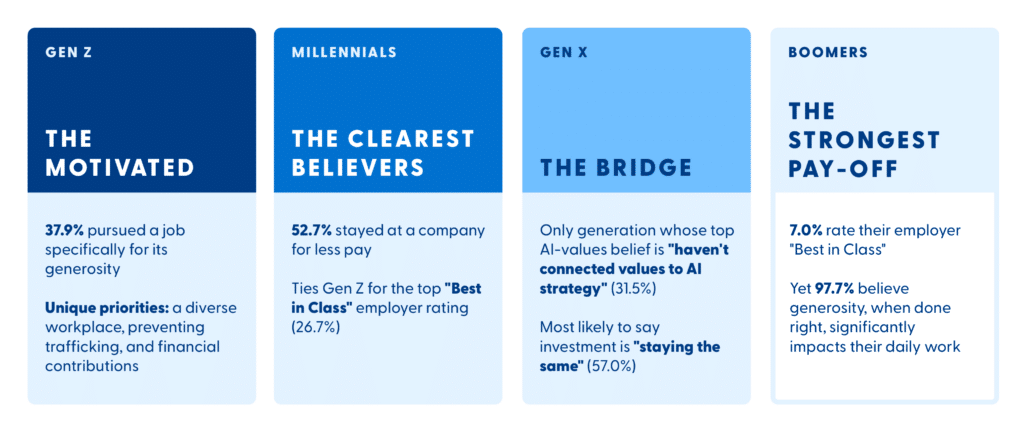
For every generation — Gen Z, Millennials, Gen X, and Baby Boomers — consistent, genuine care for people significantly improves loyalty and engagement. But concerns, motivations, and reactions differ significantly depending on the generation. Understanding those differences helps executives decide which generosity investments to prioritize for their specific workforce. Learn More →
Explore further insights:

In Partnership with