An Essential Element:
Generosity's Measurable Effect on Employee Behavior
The data confirms: generosity in business matters more than ever
Nearly every employee is watching for proof that generosity exists in the company they work for. When they see it, they reward the business with something highly valuable — exceptional engagement and loyalty.
This report clarifies what type of generosity generates these returns.
Because it turns out, if you ask an executive what it means to be a generous company, you’ll get a confident response. But if you ask an employee the same question, you’ll get a significantly different answer. This disconnect has clear consequences. Realigning generosity around what employees actually value offers incredible rewards.
The Urgency: Generosity Drives Critical Employee Behavior
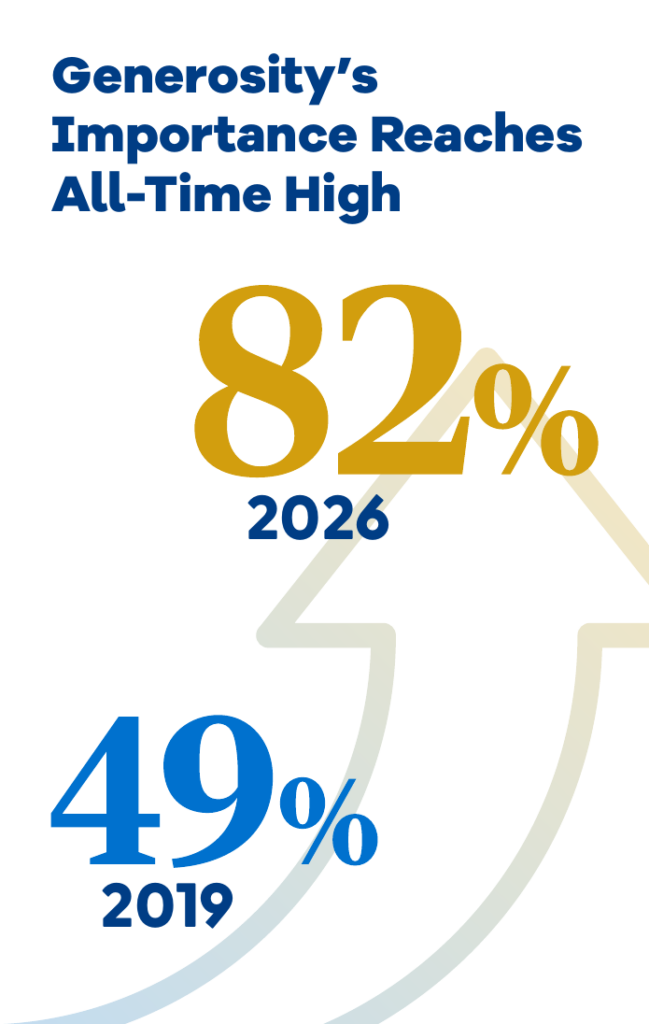
82% of employees say it’s now very or extremely important to work for a generous company — an all-time high, up from 75% in 2022 and just 49% in 2019. The “extremely important” share alone has climbed from 36% to 44% over the past five years, suggesting that gains represent increasing conviction. For anyone who thought the idea of business generosity was a trend, new data confirms that the workforce disagrees. Importance has shifted from a strong sentiment to a driver of employee behavior.
Employees don’t just say generosity matters. They work harder for generous companies.
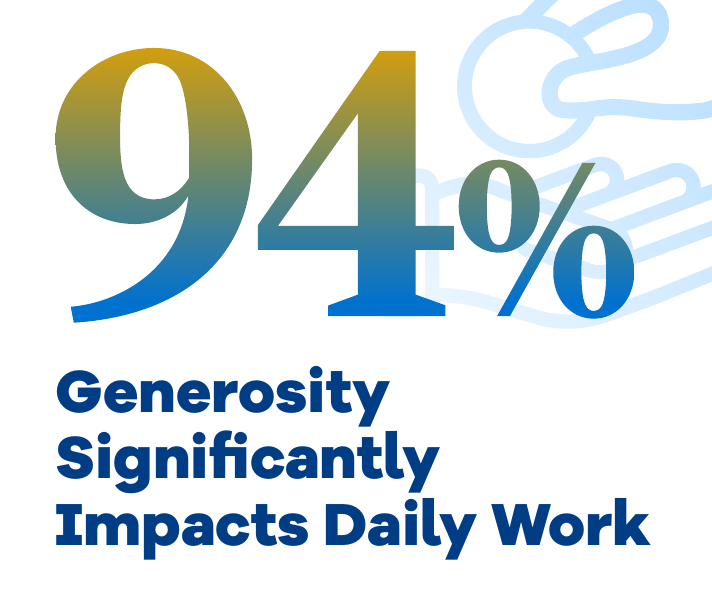
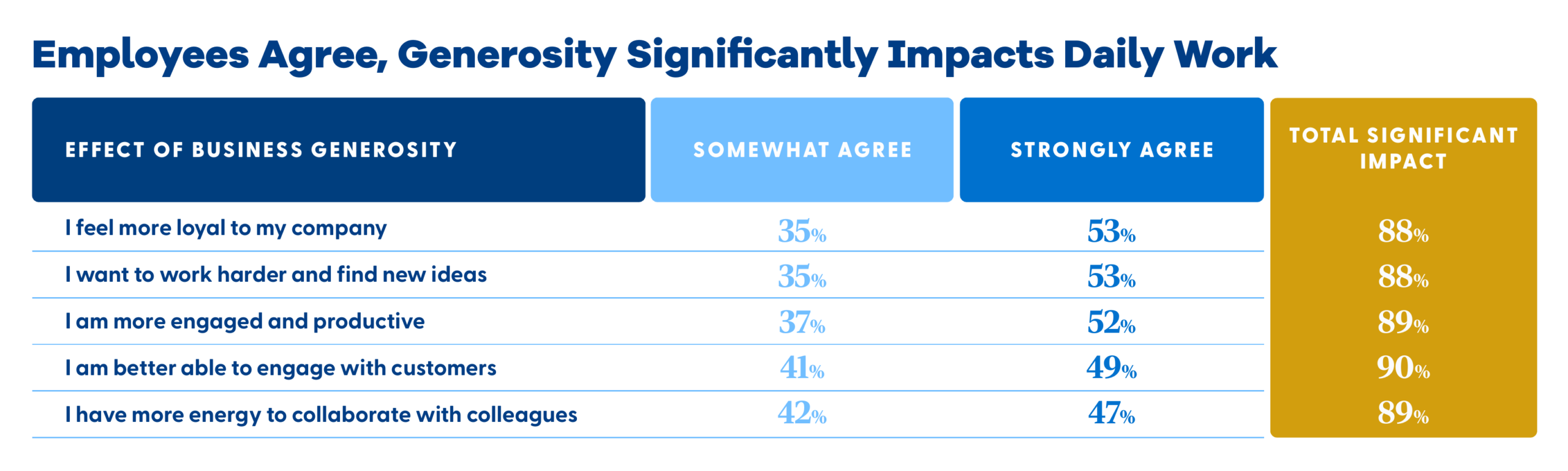
Overall, 94% of employees say that when they experience business generosity, it has a significant impact on their day-to-day work — a striking 55% strongly agree.
Employees shared specifics. More than half of employees strongly agree that a generous employer makes them more loyal, more engaged and productive, more willing to find new ideas, better able to serve customers, and more energized to collaborate with colleagues. Combine “somewhat” agree and “strongly” agree on any one of these measures, and the number lands between 88% and 90% of employees who believe that generosity has a direct effect on specific performance measures.
The Sacrifice: Generosity Influences Career and Financial Decisions
Employed adults were asked whether they had ever made an employment decision because of a company’s generosity or lack of it. Three findings stand out:
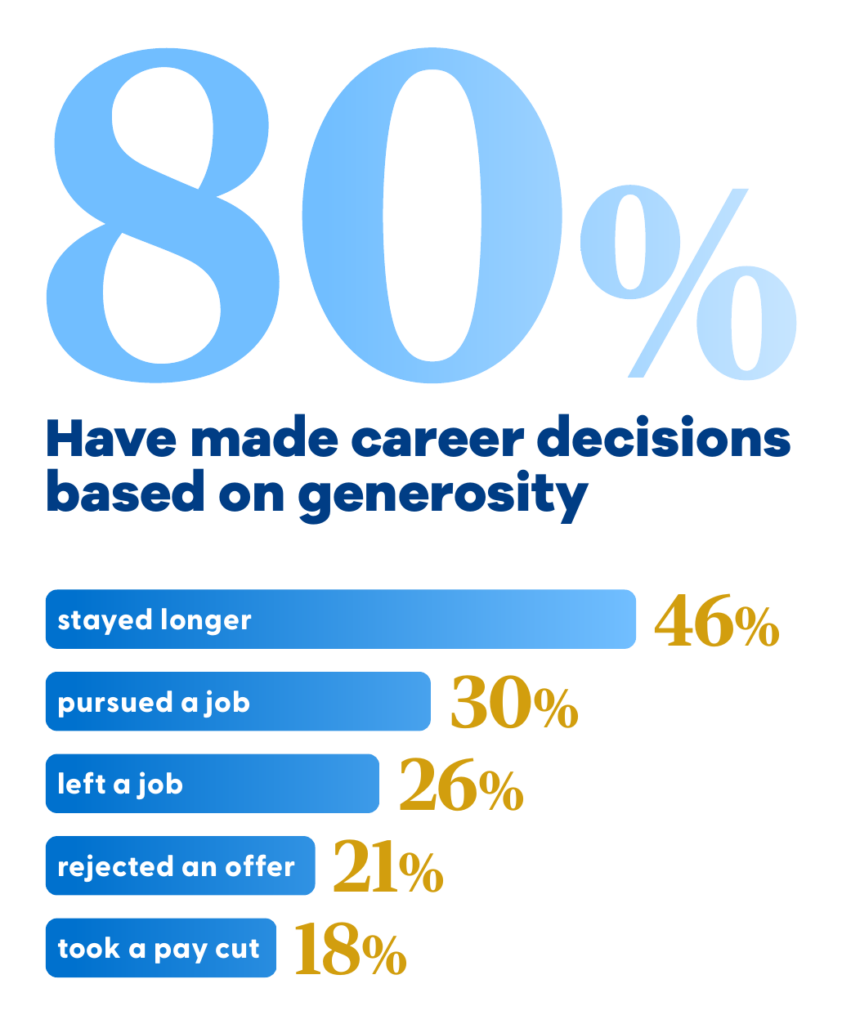
46% have stayed at a company longer, believing they could have earned more elsewhere.
This is the single most-selected response to the question. Not only did these employees knowingly make a financial sacrifice to stay with a generous employer, but these loyal respondents outperform their fellow employees across every measure of engagement this survey tracks: greater loyalty (+15.6 points), increased collaboration (+13.3 points), more effort and new ideas (+12.0 points), better customer engagement (+11.3 points), and higher productivity (+10.4 points).
One demographic note worth flagging: 52.7% of employees aged 30–45 have already made a decision to stay at a company longer thanks to the company’s generosity. This suggests the “stay for culture, not pay” dynamic is concentrated in early- and mid-career talent.
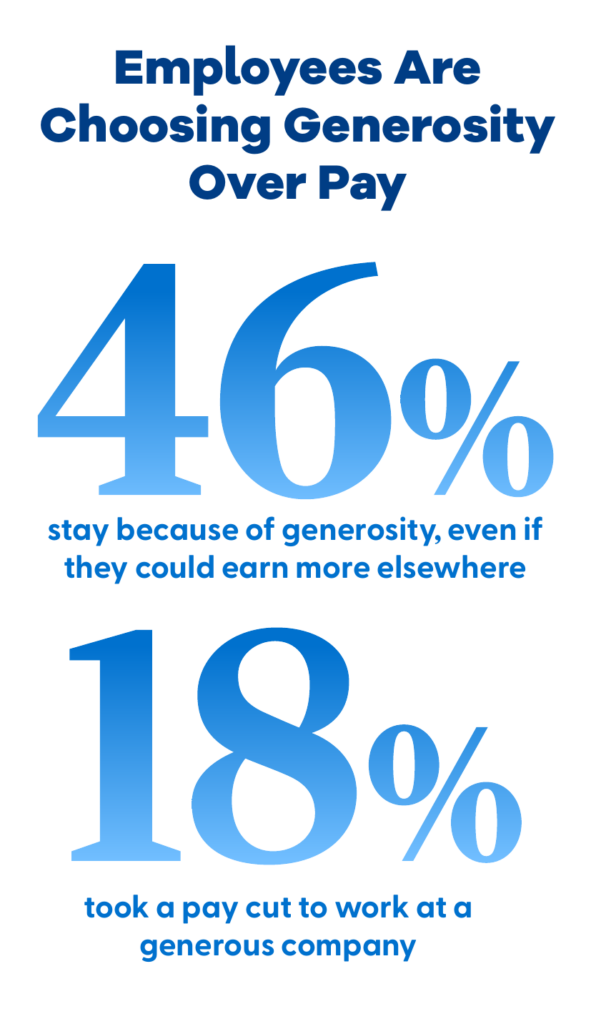
18% have taken an actual pay cut to work for a generous company.
While a smaller subset, these employees (1 in 5) gave up known income. They also rate their employer’s overall generosity substantially higher than everyone else surveyed: 78% call their employer “Best in Class” or “Above Average.” These are employees who found a generous company and know it, and they are consistently more optimistic across every dimension measured.
80% have made at least one career decision based on generosity.
In addition to those employees who reported specific compensation decisions based on generosity, 30% of employees say they have actively pursued a job specifically because a company was generous; 26% have left a job over a lack of generosity; and 21% have turned down a job offer from a company they saw as ungenerous.
Altogether, 80% of employees have made at least one concrete career decision — leaving, rejecting an offer, pursuing a job, staying, or taking a pay cut — based on a company’s generosity. And the share of those who say generosity has never influenced their career choices fell sharply in just a year, from 34% in 2025 to just 20% in 2026.
Generosity is no longer a sentimental preference held by a passionate few. Generosity drives both daily work effort and long-term career choices. When employees see generosity in action in a business, they are willing to make less, work harder, and stay longer.
The Serious Disconnect: Where Executives and Employees Miss Each Other
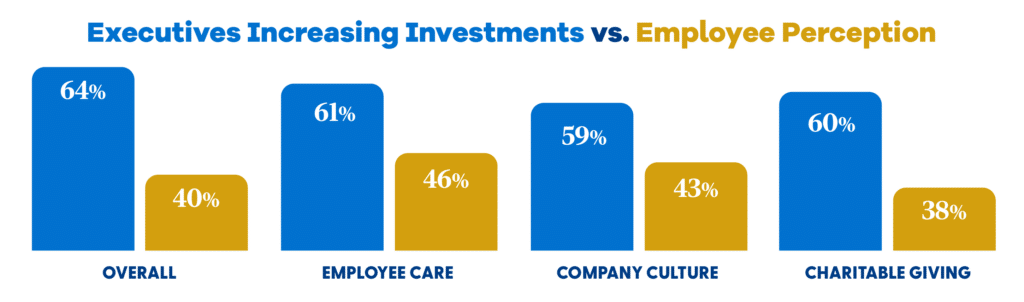
Executives and employees agree on the importance of business generosity. In fact, 64% of executives report increasing their investment in generosity, and 35% report remaining steady, which means nearly 100% are all in.
The disconnect starts with a simple question: when you think about your company’s generosity, what comes to mind first? Employees and executives answer almost in reverse.
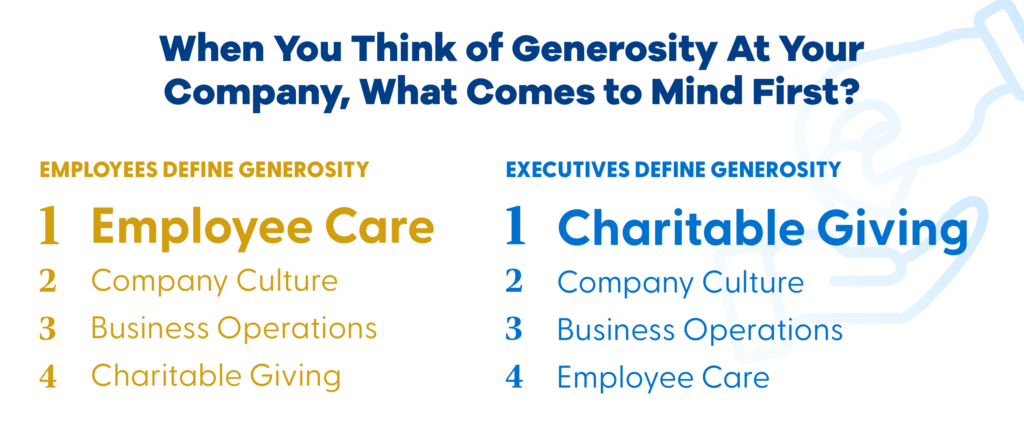
For employees, generosity starts with the everyday work environment. Employee care leads in their response (38%), then company culture and values (27%), followed by how the business treats customers and people in its supply chain (20%), and only then charitable giving to the broader community (15%).
For executives, the answer is the opposite — charitable giving is their top association when they think about business generosity (34%), followed by company culture (25%), business operations (21%), and finally, employee care ranks last (20%).
In 2026, this gap widened. Employees’ emphasis on employee care rose (35% → 38%) while their emphasis on charitable giving fell (17% → 15%). Executives moved in the opposite direction. For them, employee care fell (25% → 20%) while charitable giving rose (32% → 34%). Two groups, the same survey, drifting further apart on what “generous” really means.
The gap is more than semantics. Executives are setting their investment strategy based on what business generosity means to them. Charitable giving is an essential element, but it doesn’t convince employees that a business is generous.
Employees are asking for a consistent throughline — generosity that shows up daily in employee care, company culture, and how the business operates. When that throughline is in place, employees report the effects directly: 88% say they feel more loyal, 89% say they’re more engaged and productive, and 90% say they’re better able to engage with customers. In turn, employees will help champion the business’s generosity externally, extending the reach of any charitable efforts.
To be clear: when employees prioritize “above and beyond employee care,” they are not requesting a bigger benefits package.
46% of employees say they’ve stayed at a generous company believing they could earn more elsewhere, and 18% knowingly took a pay cut. The generosity that impacts employee behavior is less about benefits or compensation and more about how a company treats people and whether there is consistency in their humanity that can be felt across the business.
For more details, with data and strategies to deliver the generosity investments that matter most to employees see here.
The Consequence: Good Intentions Aren’t Landing
Because executives and employees are talking about generosity differently, executives consistently overestimate how well they’re delivering. 77% of executives rate their own company “Best in Class” or “Above Average” on generosity. Employees rate their companies nine points lower, and 28% of employees, more than 1 in 4, call their employer merely “on par” or in need of improvement.
The gap shows up again, and more specifically, in how each group interprets investment trends. 64% of executives say they’re increasing their investment in generosity and 35% say they’re holding steady. But only 40% of employees perceive the increase, and employees are 7x more likely to say their employer’s generosity is actually decreasing (7% vs. 1%).
Employees understand the economic pressure executives face. Among employees who believe their employer’s generosity is slipping, 48% point directly to financial pressure on the business as the reason. They are not claiming indifference or broken promises. They are not asking executives to ignore economic realities. They’re elevating the need for a little more humanity while the business works through it.
The Opportunity Ahead
Employees are letting executives know, through their daily engagement and career choices alike, that generosity matters more than money.
This report gives executives a practical tool — a category-by-category benchmark of not only where your current generosity investments are earning genuine credit but also where gaps and opportunities exist.
Missing the mark means not realizing extensive gains in engagement, productivity and loyalty, not to mention goodwill left unbanked. Executives tell us this matters more than ever as 1-in-3 say they’re increasing generosity investment specifically to build goodwill as AI reshapes the workplace, a dynamic that this report examines in detail.
Explore further insights:



In Partnership with