The AI Accelerant:
Generosity’s Role in
Protecting Company Culture
AI Is the Next Test
Earlier sections of this report establish generosity as a valuable business lever and provide a tactical benchmark for any business interested in implementing the most effective generosity. The findings below look at the force testing every aspect of business: AI.
The 2026 data shows that executives and employees agree on surprisingly little about AI except for one crucial aspect. The alignment represents not only tremendous opportunity but also a risk that generosity is uniquely positioned to answer.
The One Thing Everyone Agrees On
AI’s impact on the workplace isn’t landing well: 67% of employees and 54% of executives report mixed or negative feelings about it. When given a wide range of options for how AI could negatively affect the workplace, 43% of both employees and executives named loss of human connection and damage to company culture. It is the single point of full agreement in this entire survey.
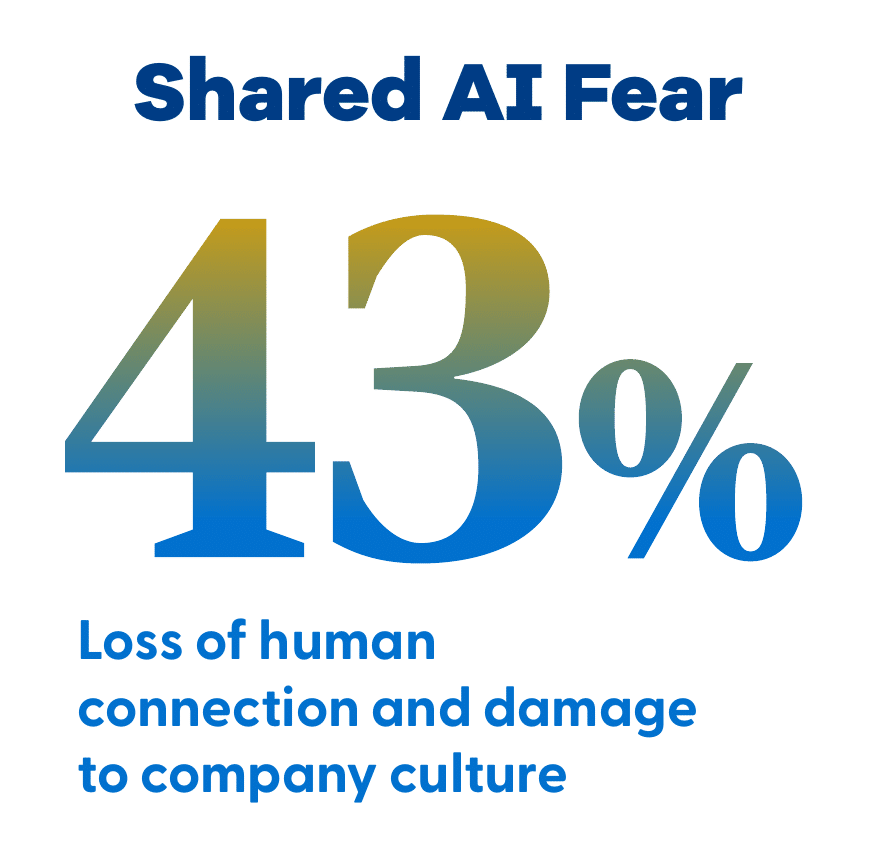
This shared fear signals that AI represents a major risk to the company culture leaders have spent years building.
Executives see other risks more clearly than employees do. They’re far more likely than employees to raise concerns about role elimination (41% vs. 24%) and loss of creative or critical thinking skills (44% vs. 34%) as negative impacts of AI.
But it is the fear both sides name equally — loss of human connection — that generosity is built to address.
Values Under Pressure
Another revealing data point in this AI conversation isn’t about optimism or pessimism. It’s about whether a company’s stated values are holding up as AI drives decisions.
When asked how well their company’s values are shaping its AI choices, the single most common employee answer isn’t skepticism but a diagnosis of employers trying and losing ground: 33% of employees say their company is “trying to let values guide us, but AI moves faster than our framework.”
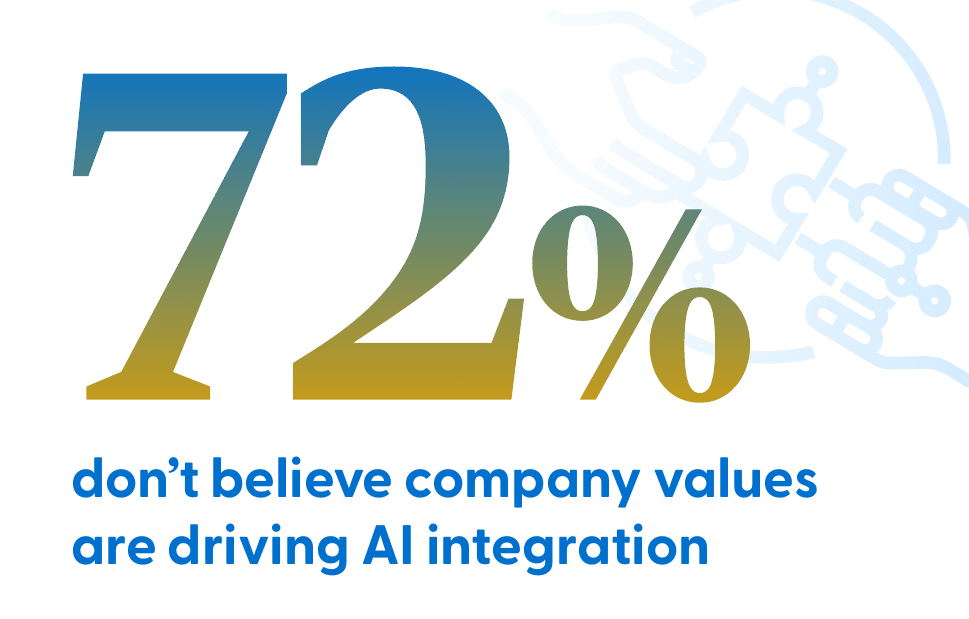
Another 22% of employees say their company hasn’t yet connected its values to its AI strategy at all, and 17% see AI adoption as driven purely by efficiency and cost, with values not a factor.
This raises the following red flag: 72% of employees do not believe that company values are actively driving AI integration. That’s 3 out of 4 employees watching their company navigate the most significant workplace transformation in a generation without values as a compass or without noticing values in play at all.
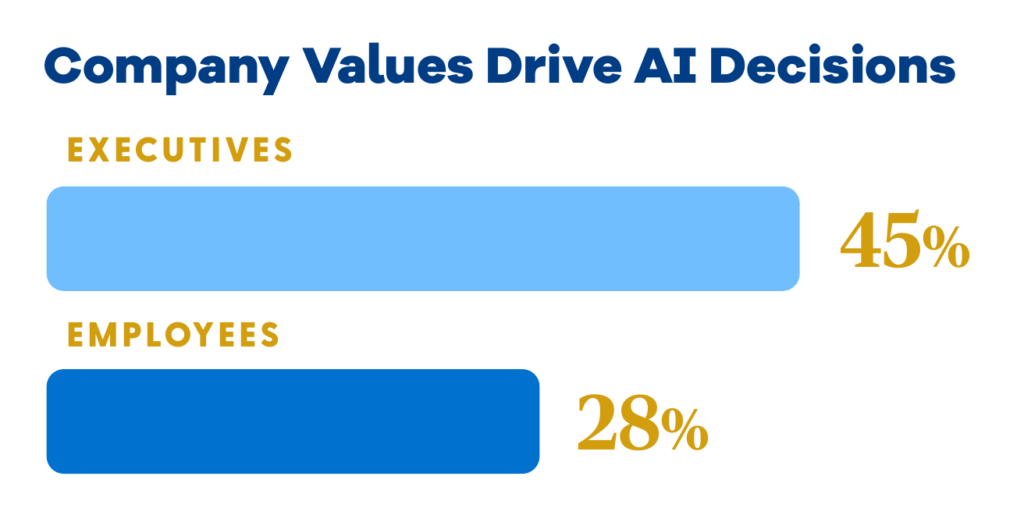
Executives are considerably more confident: 45% say their company’s values are actively shaping how AI is implemented, compared to just 28% of employees who agree. This seventeen-point gap likely reflects executives grading their intentions versus employees reporting what they are experiencing.
This sits inside the larger question about whether company values are designed to guide decisions when real pressure hits. 84% of executives say values play at least some role in their hardest calls regarding budget cuts, restructuring, and responding to economic pressure, but only 52% call values a primary guide and 13% call them purely aspirational. AI is now the live test.
Shared Optimism, Different Reasons
Executives are considerably more optimistic about AI’s overall impact than employees (46% vs. 33% call it “mostly positive”), while employees are nearly twice as likely to call it “mostly negative” (11% vs. 6%).
But there’s real common ground. Both groups rank faster decision-making and better access to information as the top expected positive benefits (51% of executives, 33% of employees).
From there, employee expectations get more personal and more modest. They hope for better work/life balance (28%) and new opportunities to build skills (28%). Executives are focused on what AI will do for the business. Both sides are watching closely for what it costs them in connection and culture.
The data in this report points to a solution that isn’t about big-budget items. It is a resounding cry for a renewed focus on generosity and the humanity behind it.
What Employees Are Actually Asking For
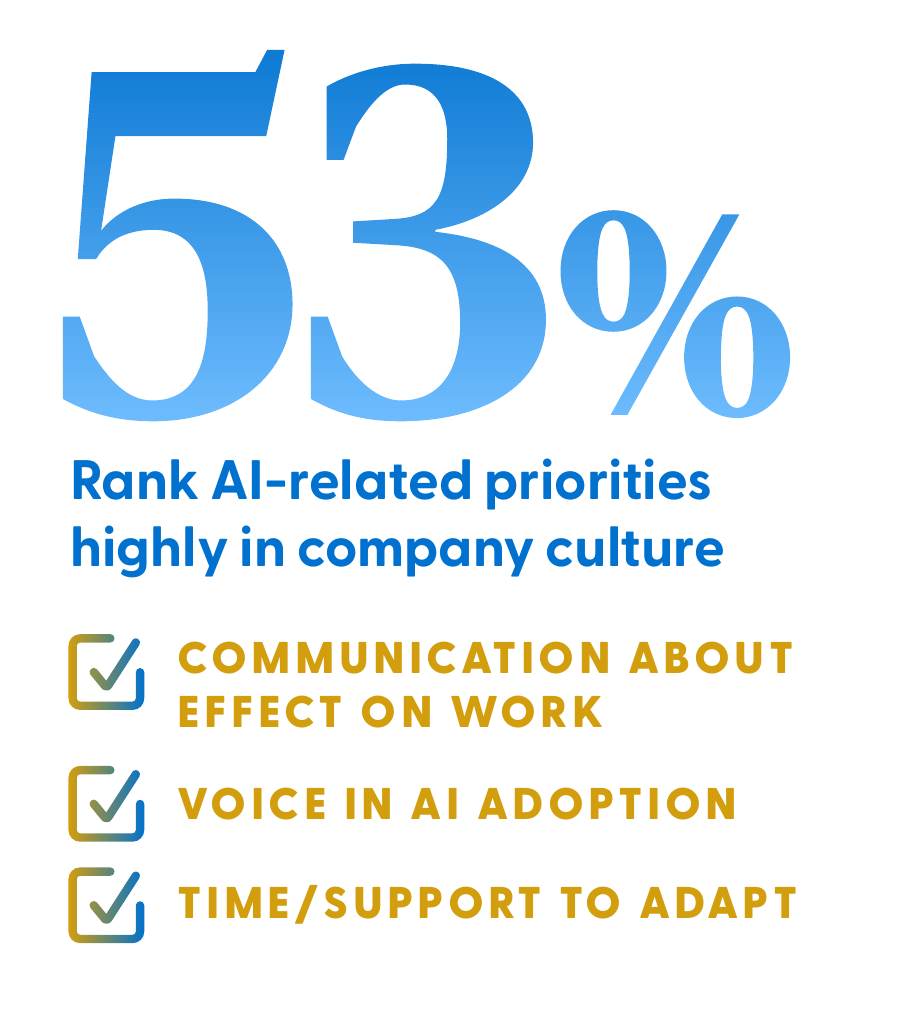
When we asked employed adults to weigh in on how generosity shows up in company culture, 53% selected at least one AI-related item among their top two most important priorities. This group of employees is more likely to say AI’s impact is “mostly positive” but also more likely to rate loss of human connection as the highest risk.
Employees paying close attention to AI are both the most hopeful about it and the most clear-eyed about what it threatens. And they have a few specific asks:
- Communication: Clear, plain-language communication about how AI will affect the work is the foundational request. Yet only 46% of executives say they are currently offering this. Employees aren’t asking for certainty about what AI will do. They’re asking to be told what the company knows as it learns it. That’s a low-cost, high-return investment.
- Employee voice: Employees want input into how AI changes their work. 43% of executives report offering this. This is a reasonable starting point but leaves a meaningful share of the workforce watching decisions get made without their involvement.
- Time to adapt: Time and support to adjust as AI changes the work rounds out the top three requests, with 40% of executives reporting they offer it. Of the three, this is the most concrete request for training, transition time, and resources to navigate real changes to how work gets done.
The companies already delivering on these three are earning something increasingly rare: the trust from a workforce that’s watching closely.
Where This Is Headed – Executive Perspective
When asked how AI will affect their investment in generosity over the next two years, 36% of executives expect it will enable an increase in investment, and another 34% expect no meaningful change. Combined, this means 70% expect their commitment to hold steady or grow. Given how consistently executives have already backed generosity year over year, that reads like greater intent rather than hesitation: executives expect AI’s efficiency gains to fund more generosity.
The simple guidance: executives’ positive intentions need to be visible because employees are watching for the opposite outcome.
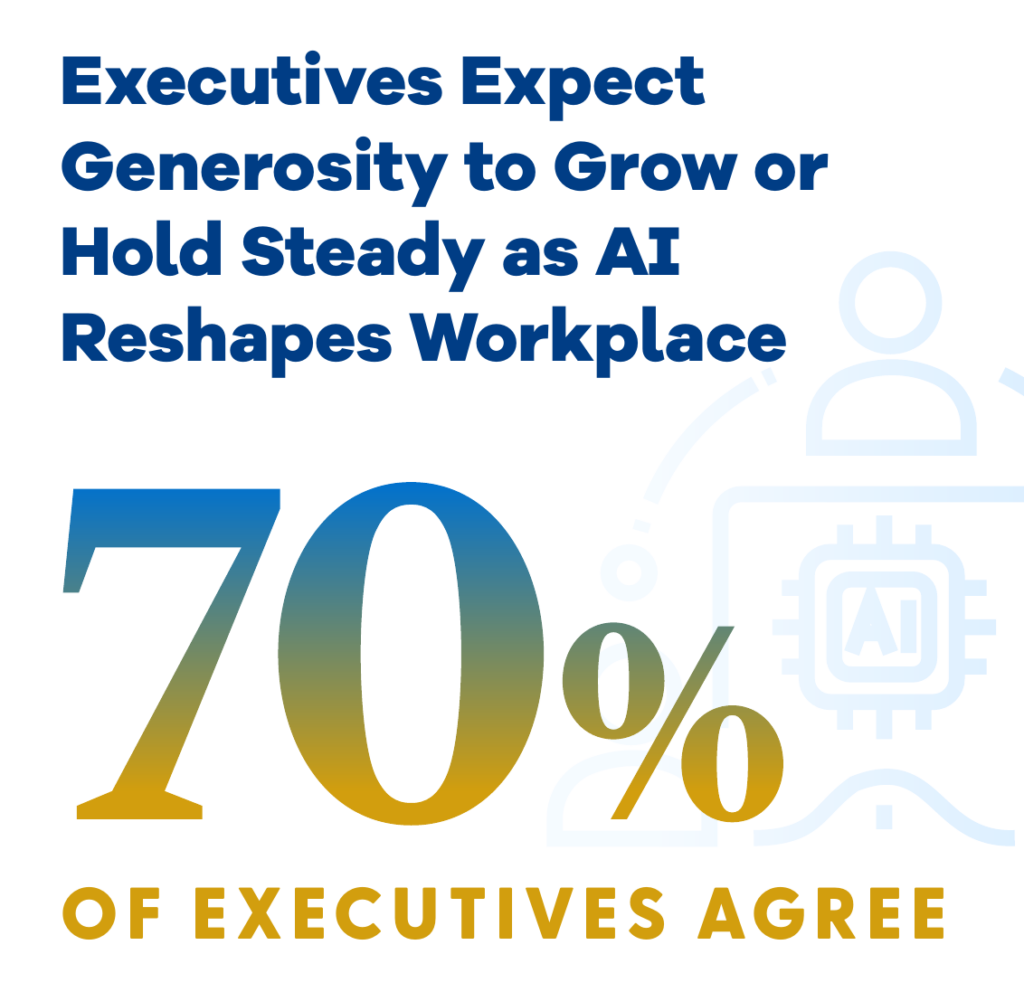
Employees are three times more likely than executives to expect generosity to become less important as AI reshapes the workplace (15% vs. 4%). Therefore, converting AI’s efficiency gains into more generosity in the workplace and making sure employees see that conversion is an opportunity for executives to ensure that their employees see them double down on protecting human connection.
The Throughline
Positioned correctly, generosity is a direct answer to the shared concern this survey unearthed: the fear that AI will cost the workplace its human connection. The companies building a track record now — not as a charitable line item but as a working guide for how people are treated at every point of contact — are the ones positioned to convert this year’s shared anxiety into next year’s trust.
Explore further insights:

In Partnership with