Driving Exponential Engagement:
Generosity's Generational Differences
Employees Devout Their Careers to Companies That Treat People Generously
Employees who experience that kind of above-and-beyond generosity report higher loyalty, more effort, and stronger engagement. A striking number say they have stayed in a lower-paying job or even turned down a higher-paying offer, specifically to stay somewhere they consider generous.
This section of the report looks at that same data across the four generations Gen Z (18–29), Millennials (30–45), Gen X (46–61), and Boomers (62–80). By understanding where these groups agree and where they diverge, executives can tailor their strategies for their particular workforce.
Generosity Unites the Workforce
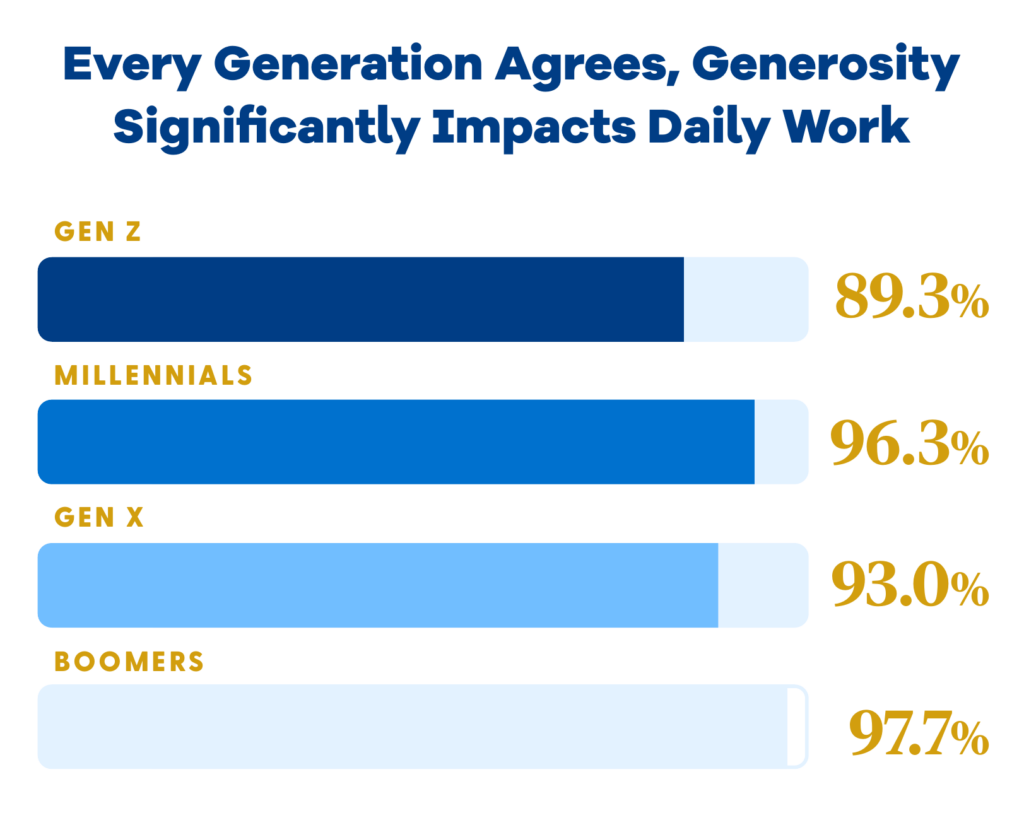
When it comes to business generosity, the four generations are remarkably aligned. Employees at every career stage elevate humanity inside the business: first and foremost, employee care that goes above and beyond. It’s the top answer for Gen Z, Millennials, Gen X, and Boomers alike, with little to no statistical difference (35–41%). The same holds when asked whether their employer’s generosity has a significant impact on their day-to-day work experience; all four generations strongly agree at roughly equal rates.
It is worth remembering from earlier chapters: when employees prioritize “above and beyond employee care,” they are not requesting a bigger benefits package. Nearly half of employees (46%) say they’ve stayed at a generous company knowing they could earn more elsewhere.
This confirms that the generosity that impacts employee behavior is less about benefits or compensation and more about how the company treats people and whether there is consistency that can be felt across the business.
The alignment also extends to one of the report’s biggest findings: how AI is impacting the workplace.When asked to name AI’s single biggest risk to the workplace, all four generations name the same thing — loss of human connection and damage to company culture — within a few points of each other (41–45%, with Boomers running slightly higher at 50%).
Generosity isn’t more important to one generation than another; however, the generational differences that do exist offer valuable clues for how to tailor the approach.
Gen Z (18-29): The Outlier
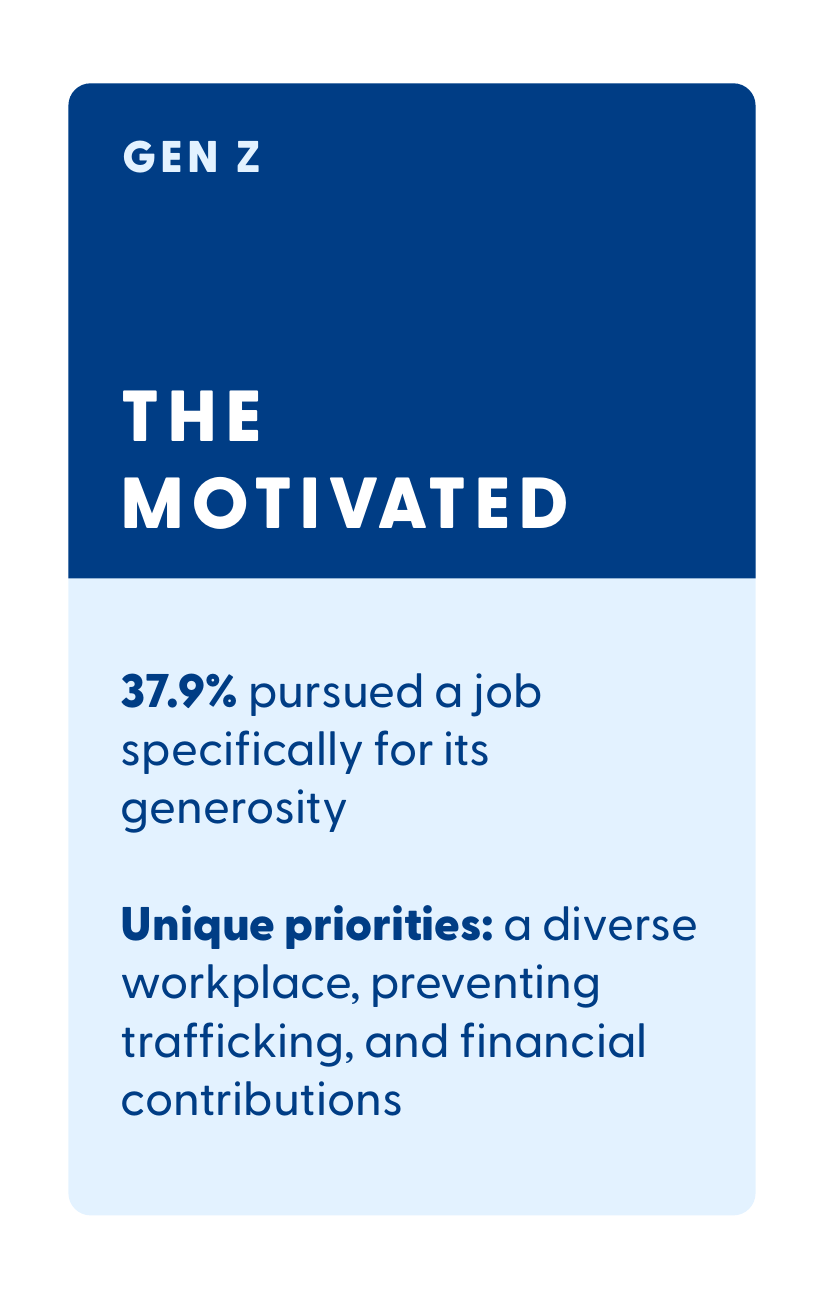
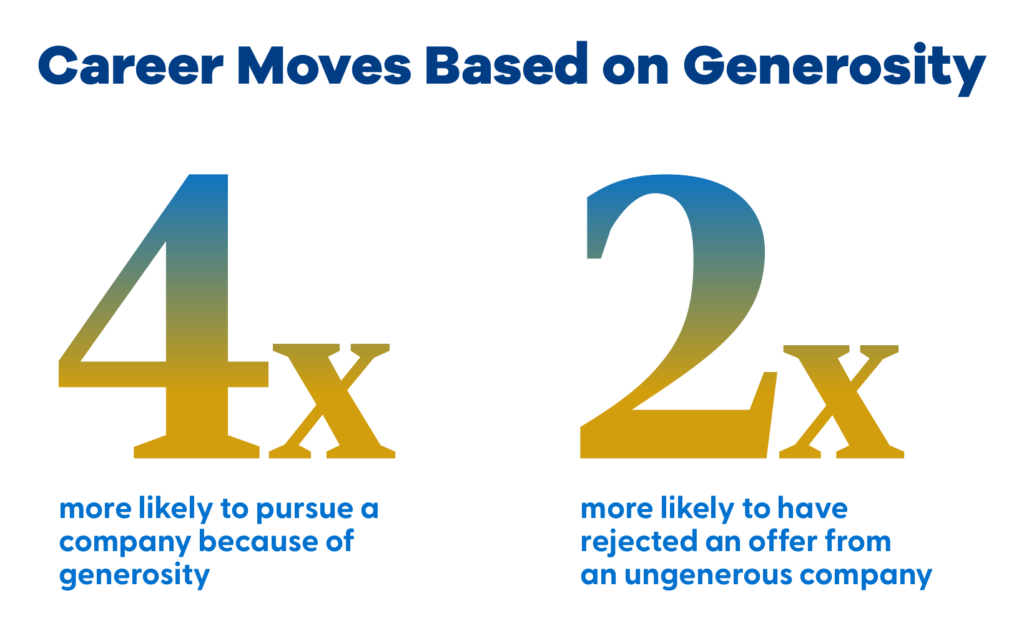
Gen Z is the most motivated by generosity. They are far more likely to say they have actively pursued a job specifically because a company is generous (38% vs. just 9% of Boomers — the widest generational gap in the survey), and they are also the most likely to have rejected an offer over a lack of generosity (31% vs. 17–19% for older generations).
Gen Z is also more likely than any other generation to have genuinely unique answers when it comes to their priorities:
- Company culture: Gen Z’s top priority is a workplace with different backgrounds, experiences, and points of view (39%); the other three generations rank leaders communicating openly highest.
- Business operations: Gen Z’s top priority is preventing child labor and human trafficking in the supply chain (43%). Every other generation puts genuine care for customers first by a wide margin (52% of Millennials, 58% of Gen X, 70% of Boomers).
- Community giving: Gen Z’s top pick is financial contributions (43%); every other generation ranks PTO for volunteering or matching gifts higher.
None of this makes Gen Z a harder generation to win over; it just means it is a different one to win over. In fact, they tie Millennials for the highest “Best in Class” ratings of their own employer’s generosity (27.2% vs. 26.7%), far ahead of Boomers (7%), which means Gen Z is happy to recognize employers who are delivering on generosity.
Gen Z is the generation most willing to act on generosity and have priorities that are unique to them.
Millennials (30–45): The Clearest Believers
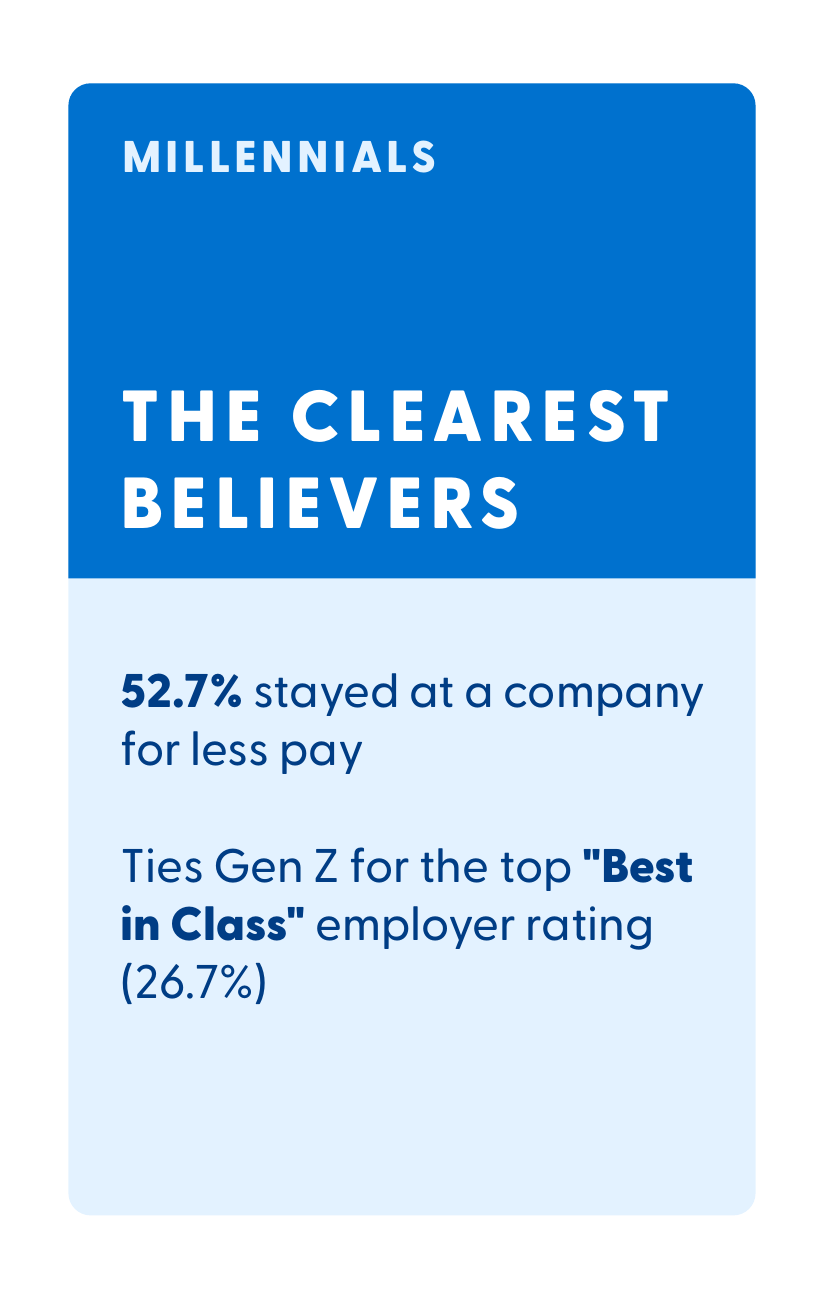
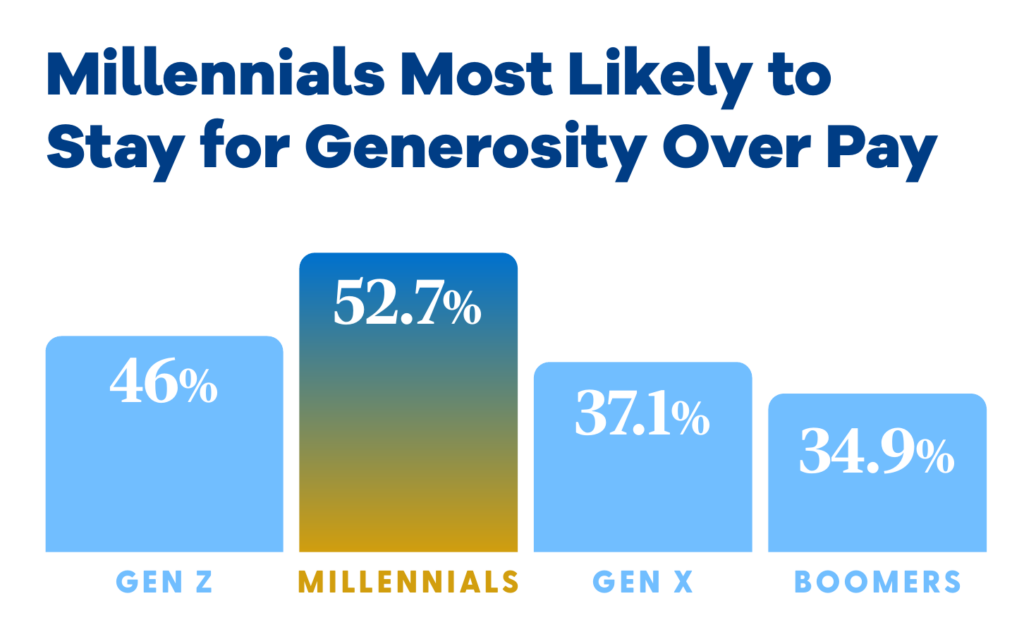
As the largest percent of the workforce right now, Millennials are the most convinced that generosity motivates them to stay with an employer. A remarkable 52.7% say they’ve stayed at a company specifically because of its generosity, even though they could have earned more elsewhere, the highest of any generation, ahead of Gen Z (46%), Gen X (37.1%), and Boomers (34.9%).
Their belief in the power of generosity shows up consistently:
- Impact on work performance: Millennials are the most likely generation to strongly agree that generosity has a “significant impact” on their day-to-day work (58%), and they out pace other generations when it comes to generosity’s impact on their loyalty, effort, engagement, and customer interactions.
- Belief in their own employer: Millennials tie Gen Z for the highest “Best in Class” ratings of their employer’s generosity (26.7% vs. 27.2%), far ahead of Boomers (7%).
- Pragmatic when it comes to cost: When their employer’s generosity investment holds steady rather than grows, Millennials credit their employer for maintaining their investment because “employees value it” (39%).
This is the generation most likely to buy into generosity fully and to reward it with their strongest performance and loyalty.
Gen X (46–61): The Bridge, With One Distinct Position
Gen X rarely sets the extreme on any measure. They consistently take the middle ground between younger enthusiasm and Boomer skepticism. But on one question, they stand alone:
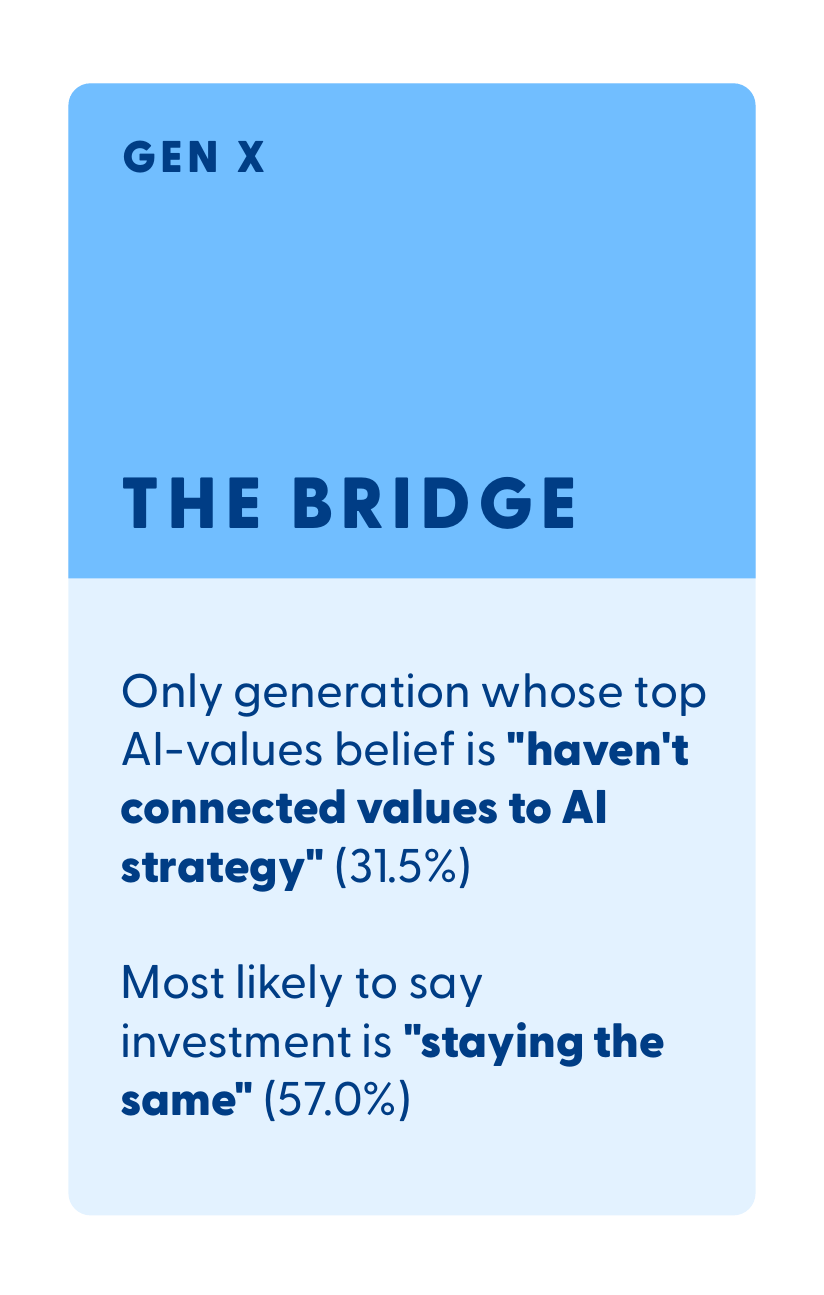
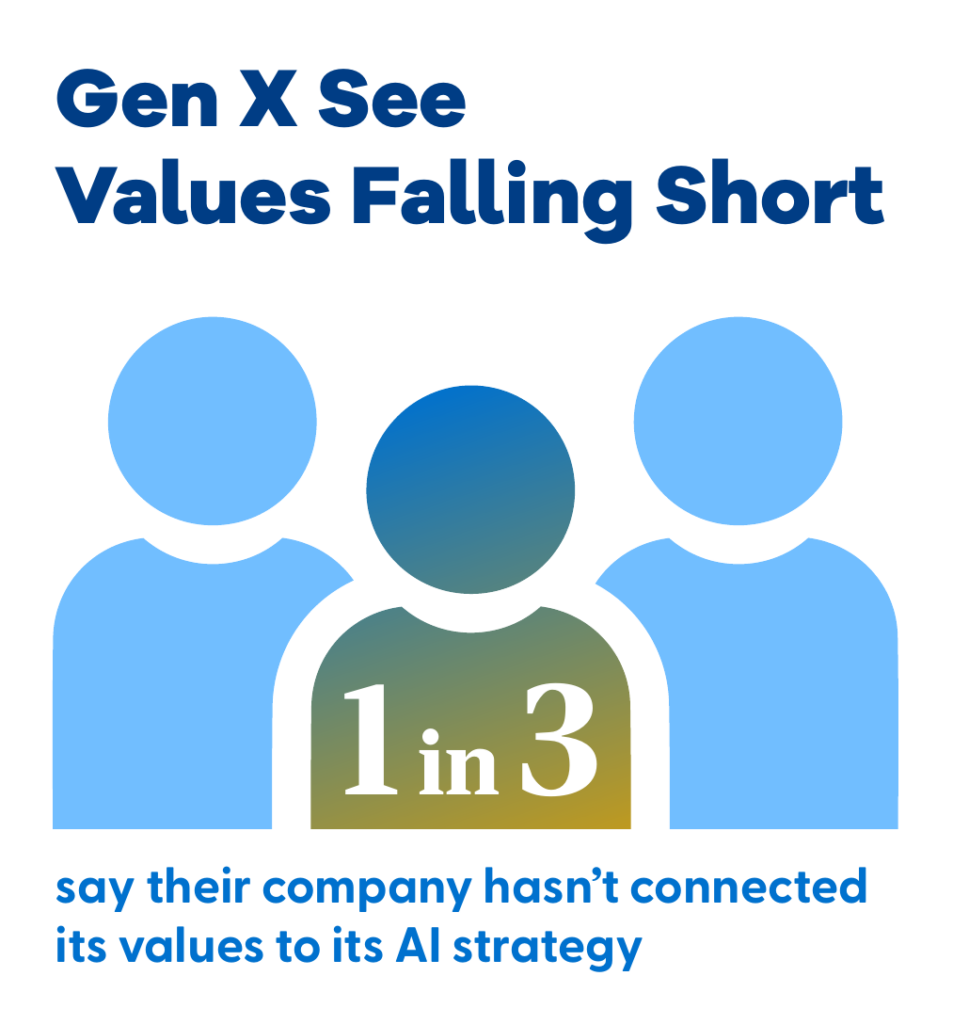
Values aren’t guiding AI implementation. Gen X is the only generation whose top response about the role of values in their employer’s AI implementation is “we haven’t yet connected our values to our AI strategy” (31.5%). Every other generation is more likely to say their company is at least trying to let values guide those decisions, even if the effort can’t quite keep pace with how fast AI is moving.
This points to a bigger question that runs throughout this year’s data: whether a company’s stated values hold up against fast-moving changes that put them to the test. For Gen X, more than any other generation, the answer right now is no.
That Gen X watchfulness shows up more broadly:
- Skeptical of overall generosity investment: Gen X is most likely to say their employer’s investment in generosity is “staying the same” (the highest share of any generation at 57%), and its leading explanation is that executives feel like they are already doing enough (41%). Even though executives report increasing their generosity investment across nearly every category, Gen X doesn’t see it.
- Giving businesses the benefit of the doubt: Among those employees who feel their employer’s investment is genuinely dropping; Gen X and Boomers are considerably more likely to point to financial pressure on the business (65.5%). These employees understand the economics and aren’t asking executives to ignore that math, but they join other generations in their request to demonstrate greater humanity while the business works through it.
Gen X isn’t the most convinced generation that their own employer is delivering, but it is the most generous in how they explain the shortfall.
Boomers (62–80): Skeptical of Their Employer, Convinced of the Idea
Boomers are more critical of their own employer and less likely to say generosity has shaped their career choices, and yet they are the most ardent believers once they’re convinced generosity is real.
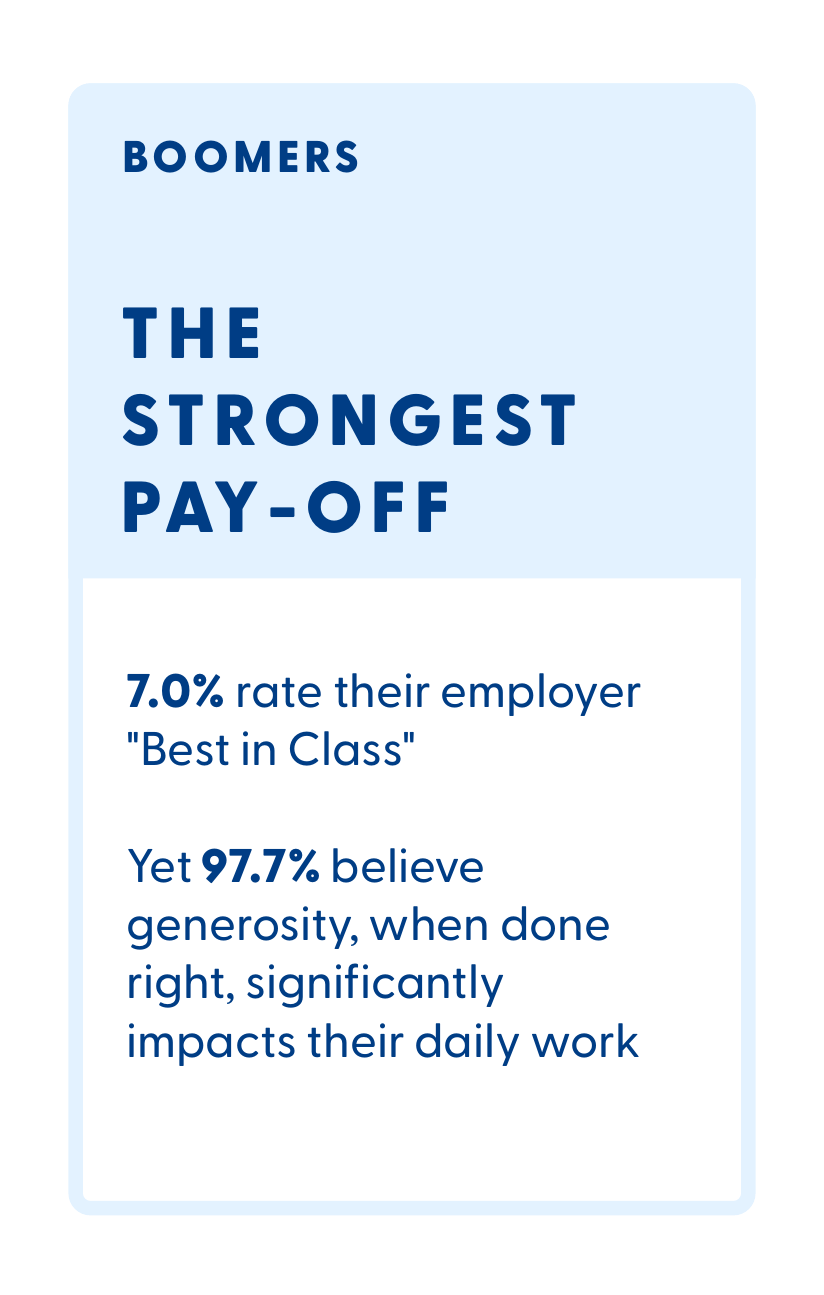
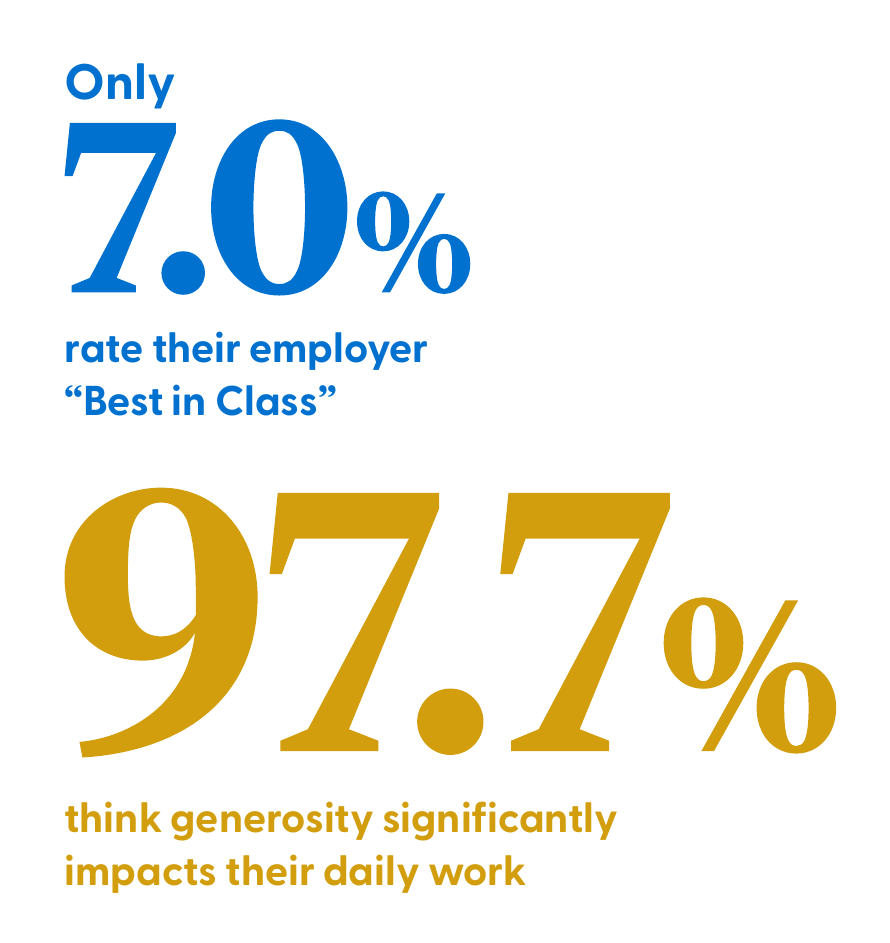
- Most skeptical of their own employer: Only 7% of Boomers rate their employer “Best in Class,” against roughly 20–27% for every other generation, and 18.6% rate their employer as having “Room for Improvement,” also the highest of any generation.
- The strongest payoff once convinced: 97.7% of Boomers believe generosity has a significant impact on their daily work experience, the highest of any generation. Additionally, Boomers top the generations when it comes to generosity affecting their loyalty (95.3%), desire to work harder (93%), engagement and productivity (95.3%), and collaboration (93%).
- Least likely to let generosity impact career decisions: 39.5% say they haven’t made a single career decision — leaving, rejecting an offer, pursuing a job, staying, or taking a pay cut — because of a company’s generosity or lack of it. Boomers are the only generation where “none of these” is the single most common answer, more than four times Gen Z’s rate.
- A higher bar when it comes to generosity: Boomers are the only generation to name mental health support (39.5%), disclosure of AI use (39.5%), and time and support to adapt to AI (46.5%) as table stakes for any decent company. Every younger generation still sees these as a nice plus.
- Pessimistic of AI’s impact on generosity: Boomers are also the least likely generation to think generosity will grow in importance as AI reshapes work (9.3% against 33% of Gen Z).
Paired with their skepticism about their own employer, this is the generation least willing to give credit easily but also the generation who, once convinced, report the highest impacts on their performance.
What This Means for Your Workforce
This generational breakdown doesn’t change the core finding of this year’s report. For every generation, generosity (i.e., consistent, genuine care for people) significantly improves loyalty and engagement. These findings help executives predict the response to their generosity efforts across their workforce.
If retaining early- and mid-career talent is the priority, the Gen Z and Millennial data are the most directly actionable: both groups are highly motivated by generosity and make both career and financial decisions based on it. If the goal is building credibility with a more tenured, more skeptical workforce, the Gen X and Boomer data matter more. That audience needs to see the follow-through before they’ll credit the effort, but the payoff, once earned, is the strongest in the survey.
Either way, the underlying case for investing in generosity applies to everyone. No matter your workforce demographics, prioritizing generosity is a strategic imperative driving loyalty, engagement, and business results.
Explore further insights:


In Partnership with