From Expected to Exceptional:
The Generosity Benchmark
All generosity counts. But some investments have a higher return.
Earlier, this report established that generosity is a business lever. Employees are responding with increased effort, greater engagement, and devoting their careers even if it means less compensation. Executives and employees have significantly different priorities when it comes to implementing generosity, resulting in unrealized gains.
This section of the report provides a category-by-category look at a variety of generosity investments and which ones work hardest for your business and the people in it.
For every item, employees told us how important it is to them and whether offering it earns a company “genuinely generous” status or whether a specific effort has become “table stakes” (i.e., something they expect any decent employer would provide) and therefore a glaring miss when it is absent.
We asked executives for specifics on what they currently offer. 36% are increasing their generosity investments because employees value them and 32% hope these investments will build goodwill as AI reshapes the workplace. The findings below help executives realize their goals and achieve the highest returns.
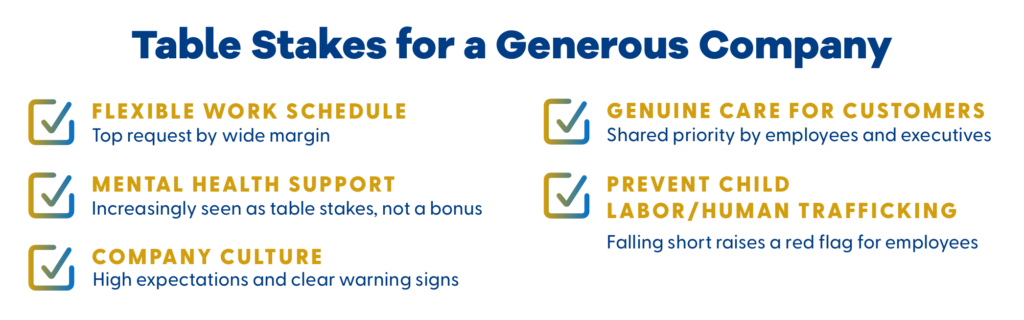
These are the items employees have come to expect from a generous employer. Most of these baseline requests do not require expanded benefits or increased budget allocation, but underdelivering here costs more than it used to: disengagement, eroding trust, and the kind of goodwill loss that compounds over time.
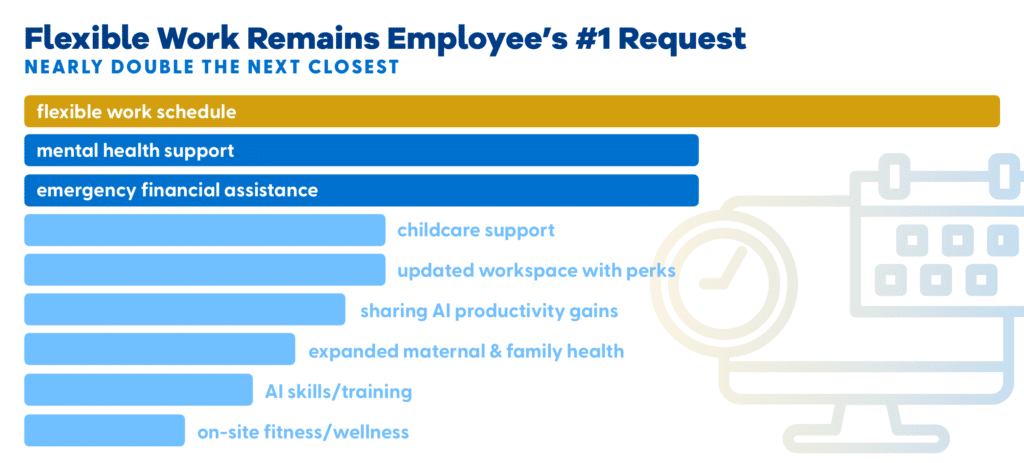
Flexible work is the clearest, largest baseline expectation in the survey.
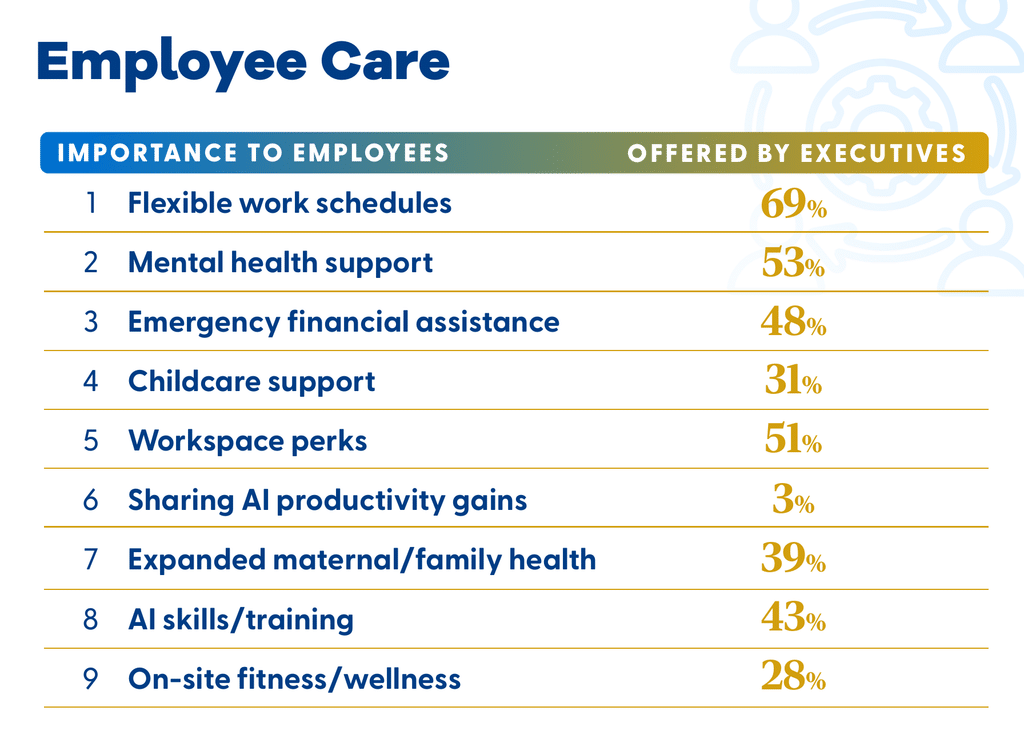
Employees’ ability to have flexibility in their work schedules remains their top priority in the employee-care category by a wide margin. This has been true for more than six years. This year, 74% recognize it as genuinely generous or appreciated since not every company offers it. 69% of executives say they offer it (though that’s a pullback from a 2024 peak of 78%).
Mental health support tells a similar story.
The percentage of employers offering mental health support climbed from 41% in 2023 to a 2025 peak of 60%, before easing to 53% in 2026. Employees continue to rank mental health support in their top two priorities.
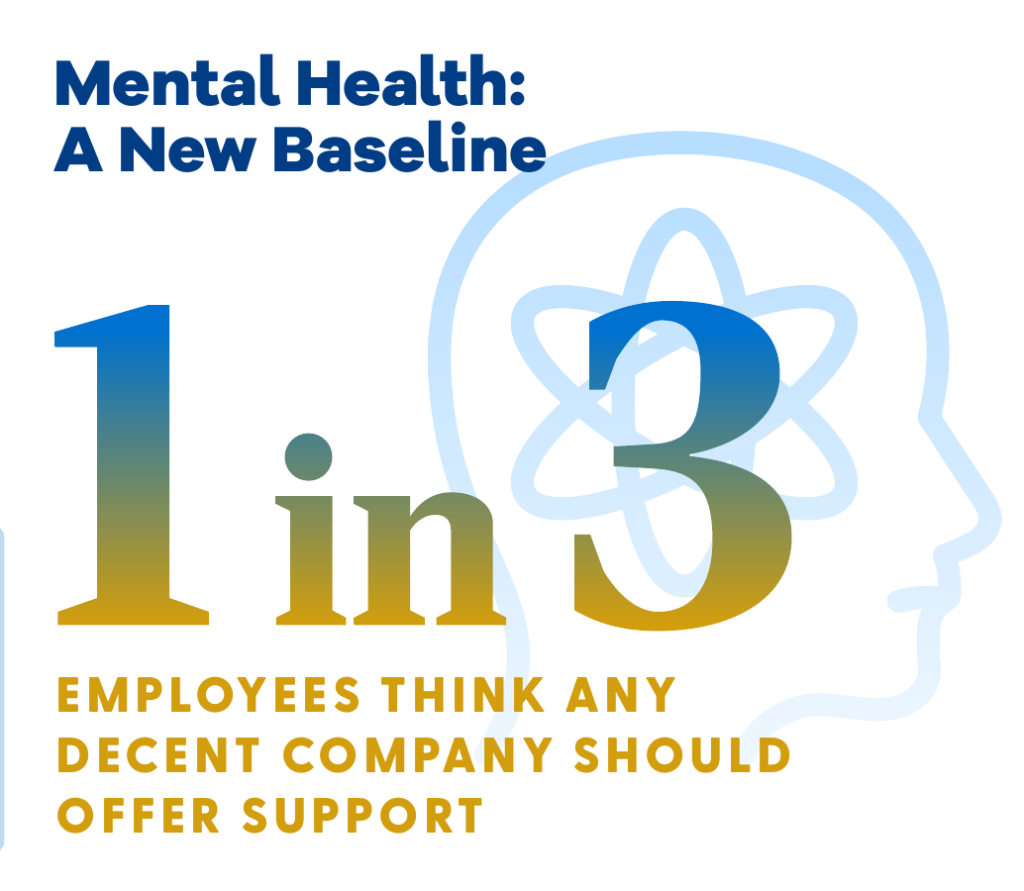
Here’s the red flag: 30% of employees now call it “table stakes,” meaning it is increasingly a baseline expectation. In fact, it received the highest table-stakes rating within the employee-care category. It still earns real credit as “genuinely generous” from 30% of employees, but failing to offer it now sends a strong signal to a third of employees.
Genuine care for customers is a high priority for everyone.
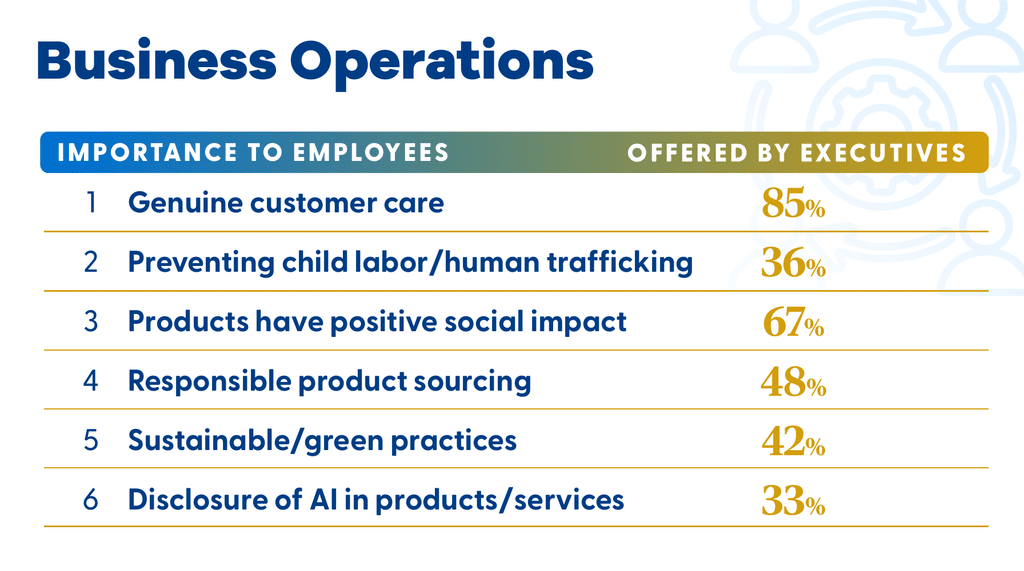
85% of executives say they are delivering genuine care for customers. 51% of employees name this as the most important when it comes to generous business operations. That alignment is good news.
There’s also a warning in the data: 37% of employees consider this table stakes, meaning falling short raises a red flag that is noticed by more than a third of the workforce. This data is simply another example of employees’ request for visible humanity across all aspects of business and, in particular, the ability for employees to actively demonstrate generosity on the front line.
Company culture is a place of alignment and where the risk hides in plain sight.
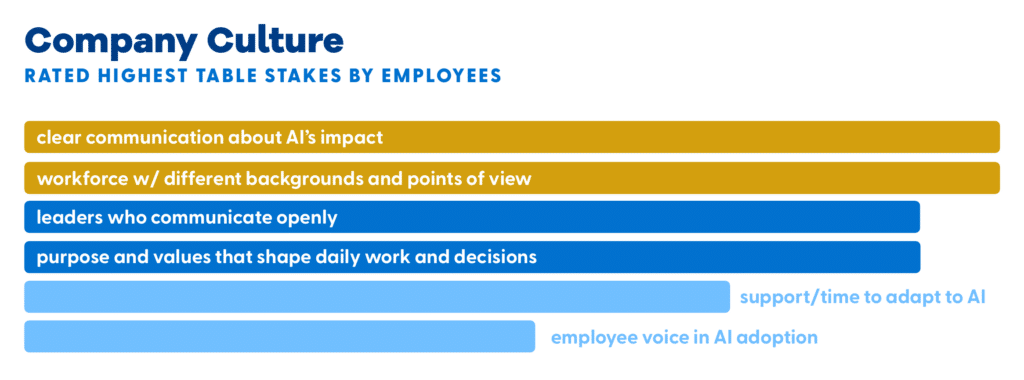
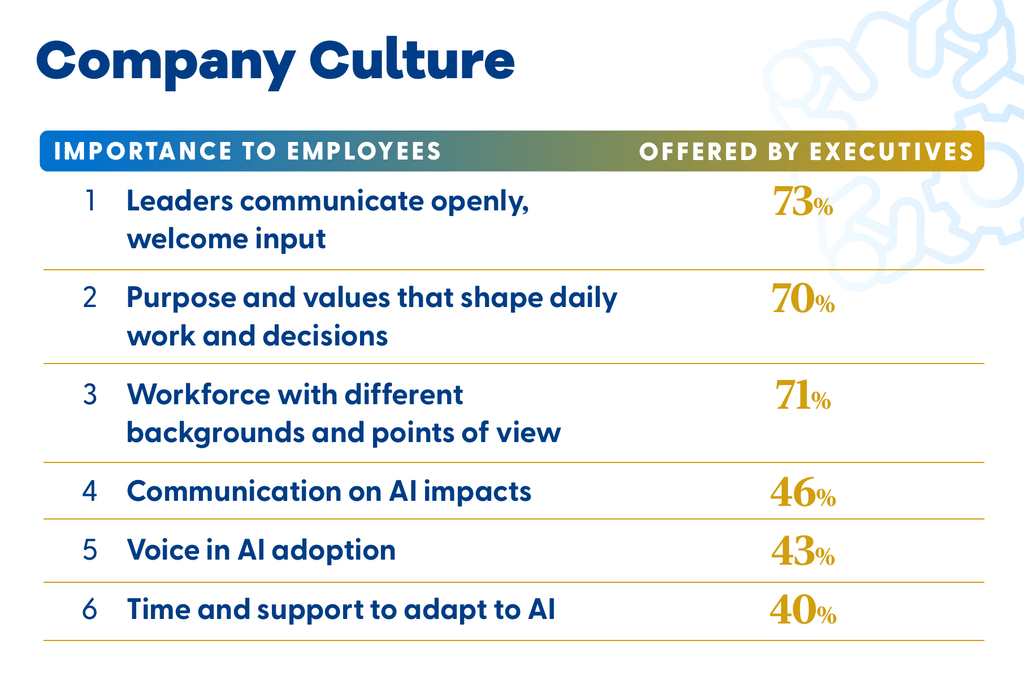
According to employees, the baseline for a generous company culture must include: 1) leaders who communicate and welcome input, 2) purpose and values that shape daily work and decisions, 3) a workforce with different backgrounds and experiences, and 4) clear communication about how AI will effect their work. These items received the highest table stakes rating of this survey (38% or higher) meaning more than a third of the workforce see these as non-negotiable.
Luckily, executives report strong commitment to three of the four including: leadership communication (73%), a workforce diversity (71%), and purpose and values (70%). The greatest opportunity for executives lies in improving their communication about how AI will affect the work, something less than half of executives report currently doing.
Preventing child labor and human trafficking in the supply chain is a fixable gap.
67% of executives are focused on products and services that have a positive social impact, but “positive social impact” in the abstract is not the same as auditing a supply chain for a specific harm. Preventing child labor and trafficking is the only item, across all categories measured, where the executive offering (36%) meaningfully trails employee importance (47%). It also carries the highest table-stakes rating of anything measured in the survey (40%).
This finding has a specific action item: check the supply chain and let employees know.
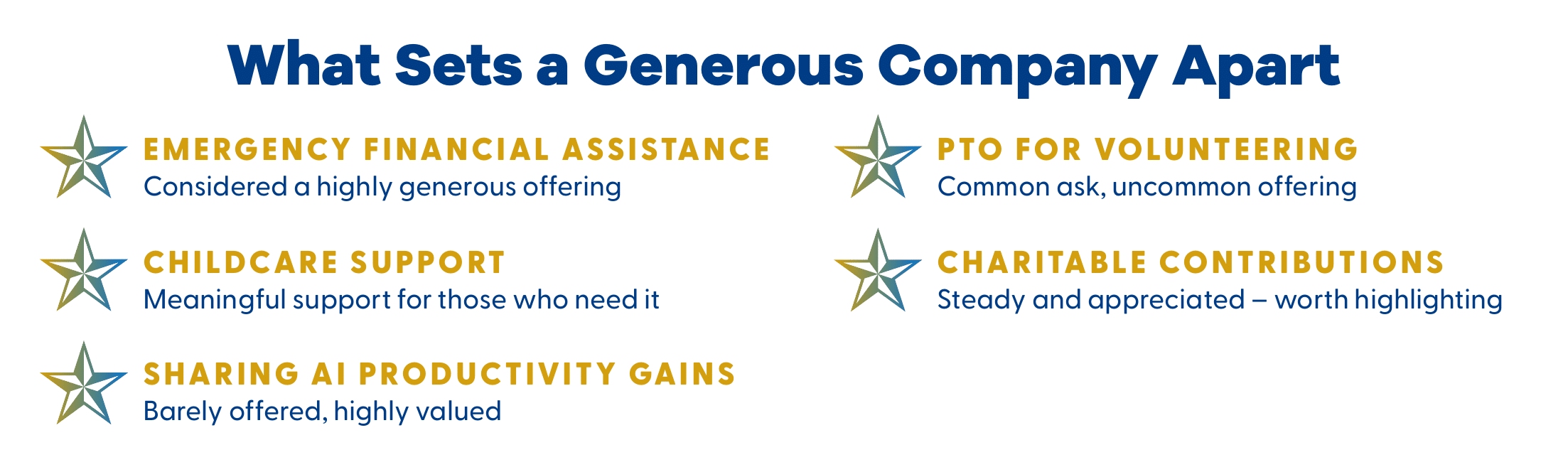
The following are investments that still earn high genuinely generous scores. This makes them the ones with real power, precisely because most companies aren’t offering them yet. These are the opportunities with the greatest potential to inspire employees and distinguish a company from its peers.
Emergency financial assistance is the standout opportunity in this survey.
It carries the highest “genuinely generous” rating of any employee-care item (38%), with an additional 39% who appreciate it because not every company offers it. The number of employers offering this has nearly doubled since 2023 (28% → 48%). It remains a top three priority for employees, and unlike mental health support, it hasn’t yet been reclassified as a baseline expectation.
It is a rare combination: very important, credited as exceptional, and trending up in terms of companies that offer it, so it is worth naming as a model investment when deciding where to put new resources.
Childcare support is the one to watch.
It ranks lower in overall importance (tied for fourth among employee-care items) but is the second-highest in “genuinely generous” credit (35%), meaning the employees who need it recognize real generosity when they see it. It signals that the company sees their life outside work as worth supporting.
Sharing in AI productivity gains
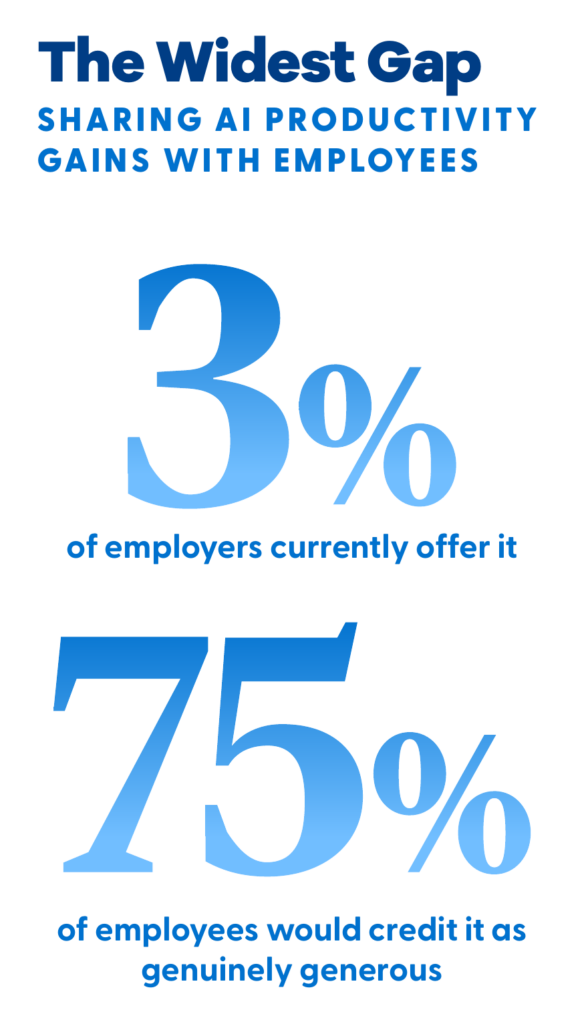
The data points to a major opportunity for employers. Unsurprisingly, only 3% of executives report having found ways to let employees share in any value created by AI-driven shifts.
As executives work through AI implementation and begin realizing productivity gains, sharing that value with employees is a largely untapped opportunity — whether that’s through more flexible schedules, a new bonus pool, or some other mechanism.
The case for moving is strong: 75% of employees say doing so would be genuinely appreciated and would set an employer apart from peers.
PTO for volunteering is one of the most underleveraged opportunities.
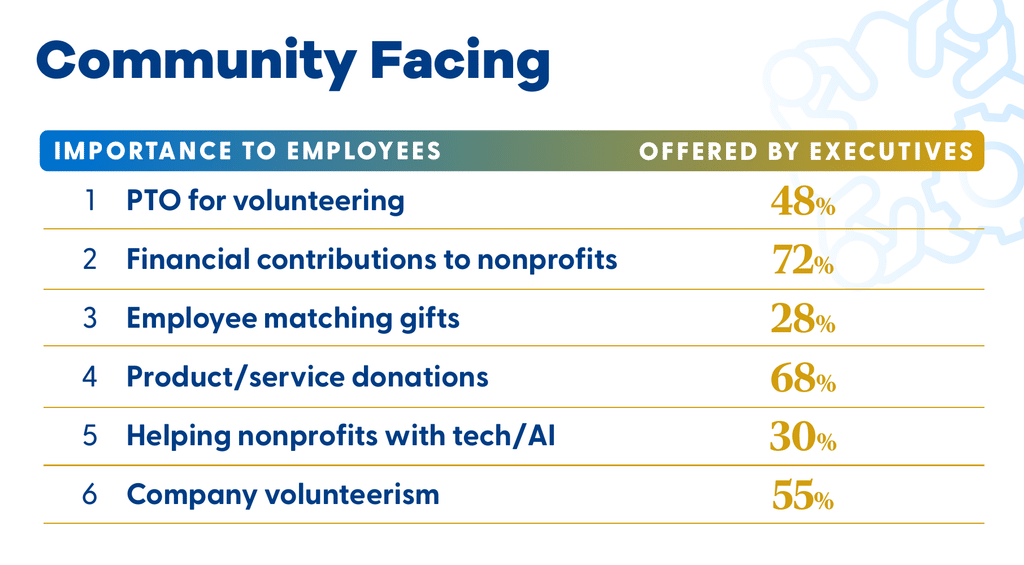
Employees rank PTO for volunteering as their top community priority (47%), it earns consistent genuinely generous credit, and yet 52% of companies still don’t offer it. What makes it different is what it communicates. A company-organized volunteer day expresses the company’s values. Paid time to volunteer for a cause an employee picked honors their values. Employees feel that distinction.
Charitable contributions remain steady and are worth protecting.
Financial contributions remain the second-highest employee priority in terms of generosity to the community. Fortunately, 72% of executives offer this and 60% say they are increasing investment. But only 38% of employees seem to notice this commitment.
All forms of financial contributions count, whether it is a direct charitable gift, a donation of services, or matching an employee’s gift — all receive high marks, with most employees (77–81%) claiming these are either genuinely generous or clearly distinguishing. The opportunity here is to continue what’s working and celebrate the commitment with employees.
None of the items above are more virtuous than the others. They are grouped here because the data shows they are currently earning outsized generosity credit relative to how many executives currently offer them. These generosity efforts still differentiate.
Quick Reference: Benchmark Your Company
Employees surveyed were asked to weigh in on a variety of activities across four categories of business generosity. This section gives executives a quick review of what employees find most important, what peers are offering, and where the opportunities lie.
Key Takeaways
- Highest praise: Emergency financial assistance ranks in the top three for employee importance and earns the highest credit for being genuinely generous.
- Greatest opportunity: AI productivity gains are where employers can truly distinguish themselves. As executives work through implementation, there’s an opportunity to consider how employees can share in the value created. Those who figure this out early will set themselves apart.
- Warning sign: Mental health support receives the highest table stakes rating as a baseline expectation for any decent company.
Key Takeaways
- Greatest opportunity: The clearest opening is around AI — communicating changes, giving employees a voice, and building in time to adapt. 53% of employees ranked at least one of these AI-related items among their top two company culture priorities, yet less than half of executives have found ways to meet that need.
- Highest genuinely generous rating: Leaders who communicate and welcome employee input.
- Warning signs: Company culture as a category received the highest table stakes ratings and the lowest genuinely generous ratings. This means that these items are now baseline expectations for any company hoping to be perceived as generous.
Key Takeaways
- Greatest opportunity and biggest credibility risk: Preventing child labor and human trafficking in the supply chain is an urgent gap. Employees consider it highly important, and 40% of employees said this is a baseline expectation for any company; however, employers often don’t disclose the steps they’re taking toward this goal. A general commitment to positive social impact doesn’t substitute for a specific effort to ensure humanity across business operations. That’s the distinction employees are drawing.
Key Takeaways
- Greatest opportunity: PTO for volunteering is the strongest opportunity — highly valued and still uncommon enough to genuinely differentiate a company that offers it. Employee-matching gifts follow the same pattern.
- Highest genuinely generous rating: Financial contributions and product donations are already well established. The opportunity here is to protect what’s working and to communicate often.
Explore further insights:


In Partnership with